
A laminated menu is a printed paper sheet sealed between two layers of plastic film. A synthetic menu is printed directly onto a plastic-based sheet, with no paper inside it and no film over it. Everything else about the comparison follows from that one difference.
Menu Zaddy prints synthetic menus only, so take the recommendation accordingly. What follows is the structural case, including the cases where lamination is the better choice, because there are several and pretending otherwise would not survive contact with your own dining room.
What is the difference between synthetic and laminated menus?
A laminated menu is paper sealed inside plastic film. A synthetic menu is printed directly on a plastic-based sheet, with no paper inside.
Lamination is a protective strategy. You start with a material that cannot handle service, paper, and you put something over it that can. The protection is real, and it is separate from the thing being protected.
A synthetic menu is not protected, because it does not need protecting. The sheet itself is the plastic. There is no layer doing a job on behalf of another layer, which means there is no interface between them where that arrangement can come apart.
Everything else in this comparison, cleaning, failure, cost, is downstream of whether the menu is one material or two bonded together. The full mechanics of how lamination is built and specified are in laminated menu printing.
Not Sure Yet? Feel It First with A Sample Pack
Heavier stock than the leading brand, for less. Spill on it, wipe it, and it still looks new.
✓ Fully waterproof, not laminated
✓ Heavy 12 and 15 mil stock
✓ Orders from just 25 menus
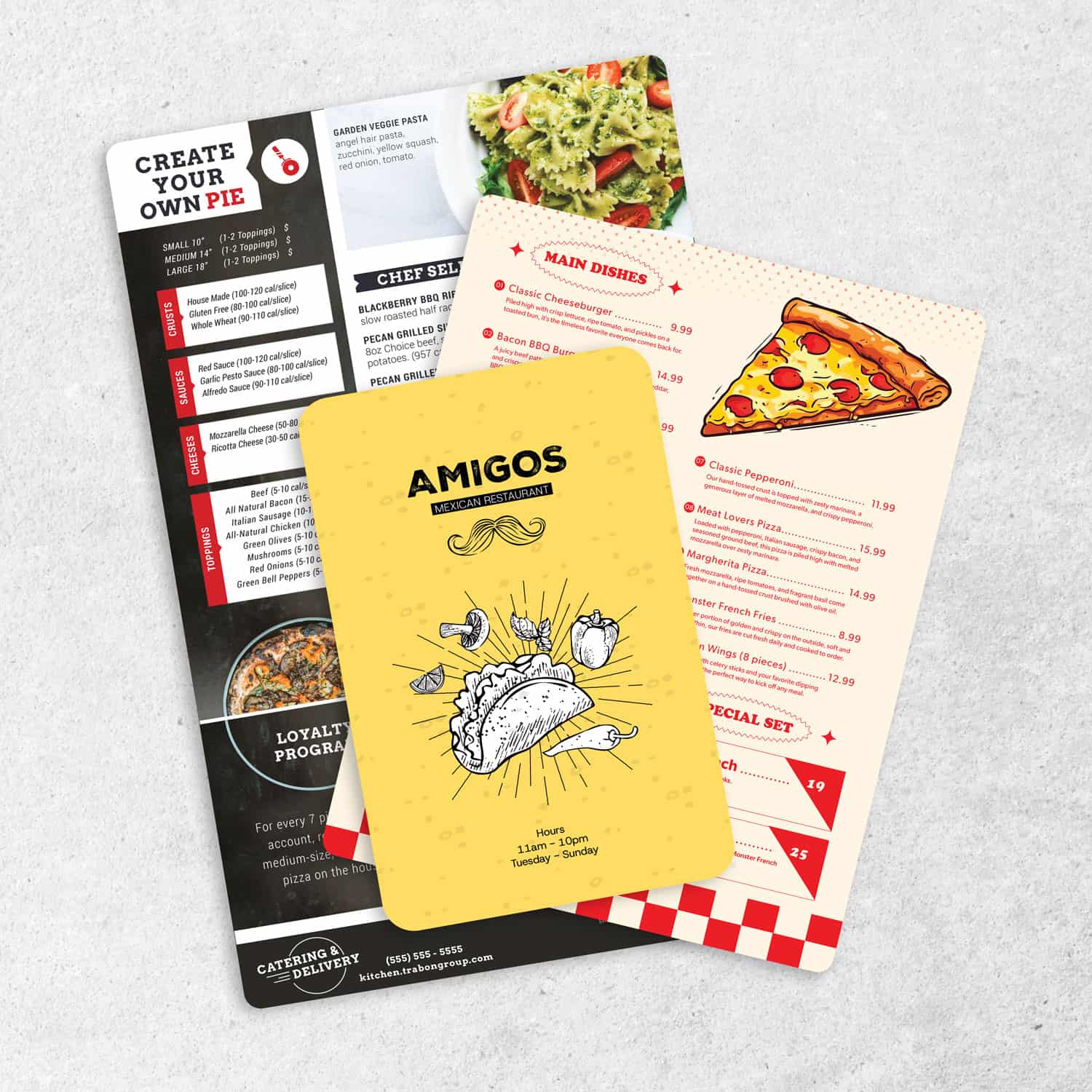
How does each one fail?
Laminated menus fail at the edge, where the bond ends. Synthetic menus have no bond and no core, so they wear at the surface instead.
Paper fails by absorbing. Liquid enters the fiber and stays. The mark is permanent from the moment it happens, which is why an uncoated menu is effectively single-use once something lands on it.
Laminated menus fail at the perimeter. The printed face is rarely the problem. The bond between film and paper terminates at the edge, and that edge is where every hand that picks the menu up applies force. A bent corner, a nicked edge, or ordinary handling lifts film away from paper. Once that opens, liquid has a route to the core, and a laminated menu cannot be re-sealed. How the edge was finished changes how exposed it is, covered in edge seal vs flush cut lamination.
Synthetic menus fail at the surface. This is worth saying plainly rather than claiming they do not fail. There is no bond to break and no core to reach, so the edge-lift failure mode is not available. What happens instead is abrasion. The printed surface takes scuffing from handling and from being stacked, and that accumulates. A synthetic menu does not come apart. It gets gradually less crisp, and at some point you replace it, usually because the menu changed first.
Which one is easier to clean?
Both wipe clean on the surface. The difference is at the edges, where a laminated menu can take liquid into the paper core.
On the face, there is not much between them. Film is non-porous and so is synthetic sheet, so in both cases a spill sits on top rather than soaking in, and a wipe removes it.
The divergence is at the perimeter. A laminated menu has a boundary where liquid can get past the film, and anything that works at that boundary, standing moisture, repeated wiping toward the edge, a lifted corner, moves the menu toward the failure described above. A synthetic sheet has no such boundary, so cleaning is the same operation everywhere on it.
For either material: dampen the cloth rather than the menu, wipe both faces and the edges, and dry fully before stacking. Do not soak and do not run menus through a dishwasher. If your operation requires a sanitizing step for items guests handle, that requirement comes from your health department rather than from the menu.
Which one costs less?
Unit price and replacement frequency are different questions. The one that matters depends on why your menus currently get reprinted.
A per-menu quote answers the first question and tells you nothing about the second. A material that costs less per sheet but gets replaced more often may or may not come out ahead, and the answer is specific to your room rather than general to the material.
You already have the number that settles it. Look at your last few reprints and ask what triggered each one. If you reprinted because prices or items changed, you were buying menus on a content schedule and the material barely entered into it. If you reprinted because the menus looked bad, you were buying them on a damage schedule, and that is the cost the quote does not show.
Your own reprint history is more reliable than any general estimate, including ours.
When is synthetic the better choice?
When menus stay in rotation between menu changes and the room is hard on them: standing liquid, humidity, sugar, grease, constant handling.
The case for synthetic is narrower than most people selling it admit. It is about rooms where menus take damage between content changes, which means the reprint is being forced by the material rather than by the menu.
Bars, where condensation sits on the table and sugary residue from syrups and mixers works into any opening it finds. Patios and outdoor seating, where humidity reaches the sheet even without a direct spill. Pool decks and waterfront service, where menus are handled wet. Breakfast and family dining, where the handling volume and the stickiness are both high. High-volume rooms where every menu passes through dozens of hands per shift.
What those have in common is not that they are wetter. It is that they attack the perimeter, which is the one place a laminated menu cannot defend.
Can you tell which one you already have?
Look at the edge. A laminated menu shows a seam, a lip, or exposed paper. A synthetic sheet is one material straight through.
Hold a menu edge-on under good light. Flush cut lamination shows a visible paper core sandwiched between two film layers, usually a lighter line between two darker ones. Sealed edge lamination shows a narrow clear border beyond the printed area and a slight lip you can feel with a fingernail.
A synthetic sheet shows none of that. The edge is the same material as the face, with no layering and no border.
This matters if you inherited your menus or changed suppliers and are not certain what you are running. It also tells you which failure mode to expect.
How do you decide?
Ask why your last reprint happened. If the menu changed, either material works. If the menus were damaged, the material is the problem.
That single question resolves most of this comparison. Everything above is detail underneath it.
If you want to judge the materials directly rather than from a description, the sample pack is free with shipping included. Put it on a table in your own room, under your own lighting, during your busiest service, and handle it the way your guests will.
For the broader category, the complete guide to waterproof menus covers synthetic stock in full.
Frequently asked questions
Is a synthetic menu the same as a laminated menu?
No. A laminated menu is printed paper sealed between layers of film. A synthetic menu is printed directly on a plastic-based sheet, with no paper inside and no film layer.
Can a laminated menu be repaired once it starts peeling?
No. The bond between film and paper cannot be restored, and a lifted or clouded area stays that way.
Do synthetic menus ever wear out?
Yes. They do not delaminate or absorb, but the printed surface takes abrasion from handling and stacking, and that accumulates.
Is synthetic worth it if we change our menu seasonally?
It depends on whether your menus survive to the scheduled reprint. If they are being replaced early because they look bad, the material is costing you a cycle.
Can both be cleaned the same way?
On the face, yes. At the edges, no. A laminated menu has a boundary where liquid can reach paper, so keep moisture away from the perimeter.
Which one prints better photography?
Both hold ink well. The practical difference is finish: lamination offers gloss, matte and textures, while synthetic stock comes as supplied.
Order a Sample Pack
Menus That Last
✓ Waterproof, not laminated
✓ Heavy 12 and 15 mil stock
✓ Only 25 Menus Minimum Order Quantity