

Menu thickness is the caliper of the sheet, meaning its physical thickness measured in thousandths of an inch. The stocks restaurants actually print menus on mostly fall between about 9 and 15 thousandths, whether they are card stock or synthetic.
The confusing part is that the printing industry measures the same property three different ways. Paper is sold by weight in pounds, card stock by points, and synthetic stock by mil. A buyer comparing a 100 lb cover quote against a 12 mil quote has no way to tell which sheet is thicker, because the two numbers are not describing the same thing.
This page explains what each unit means, which ones convert and which do not, what thickness suits which kind of menu, and why a thicker menu is not automatically a longer-lasting one.
How is menu thickness measured?
Three units are in use. Points and mil both mean thousandths of an inch and are interchangeable. Pounds measure weight, not thickness.
The industry term for thickness is caliper. Case Paper, a paper merchant, defines caliper as the thickness of paper and paperboard, expressed in points where one point equals .001 inch (Case Paper, paper thickness tables). A mil is also one thousandth of an inch. So 14 pt card stock and 14 mil synthetic are the same thickness.
Pounds are different. Paper weight in pounds refers to how much a ream of that paper weighs at its basis size, which varies by paper category. That is why 80 lb text and 80 lb cover are not the same sheet at all, despite carrying the same number.
The practical takeaway: if a printer quotes you in points or mil, you know exactly how thick the sheet is. If they quote you in pounds, you do not, and you need to ask for the caliper.

Not Sure Yet? Feel It First with A Sample Pack
We'll send you a sample waterproof menu so you can bend it, spill on it, and wipe it clean before you commit.
How do you convert paper weight to mil?
You cannot convert it cleanly. The same stated weight produces different thicknesses depending on finish, so pounds can only be mapped to an approximate caliper range.
The figures below are average calipers published by Case Paper. Because one point equals one mil, the points column is also the mil equivalent.
| Stock and finish | Points / mil |
|---|---|
| 80 lb text, coated gloss | 3.8 |
| 80 lb text, offset | 6 |
| 100 lb text, coated gloss | 4.8 |
| 100 lb text, offset | 7 |
| 65 lb cover, gloss coated | 6 |
| 65 lb cover, uncoated | 9 |
| 80 lb cover, gloss coated | 7.5 |
| 80 lb cover, dull coated | 8.5 |
| 80 lb cover, uncoated | 11.5 |
| 100 lb cover, gloss coated | 9.5 |
| 100 lb cover, dull coated | 11 |
| 100 lb cover, uncoated | 13.5 |
Look at 80 lb cover. Uncoated it measures 11.5 points, gloss coated it measures 7.5. Same stated weight, and the uncoated sheet is more than half again as thick. A quote in pounds alone tells you almost nothing about how the menu will feel.
Case Paper also notes that coated papers tend to be heavier than uncoated papers without necessarily being thicker, and that rougher finishes tend to run higher in caliper. Calendering, which presses the sheet smooth, reduces caliper without changing the weight.
So the useful comparison is caliper against caliper. A 100 lb uncoated cover sheet at 13.5 points sits between the two synthetic weights most menu printers stock. A 100 lb gloss coated sheet at 9.5 points is noticeably thinner than either.
What thickness should a restaurant menu be?
It depends on how the menu is held and how long it stays in service. A reused table menu needs body. A menu you hand out and discard does not.
Reused menus handed to guests. These need enough caliper to stay flat when held at one edge. Stocks in the low teens of points handle that. Below about 10 points a full-size sheet starts to bend in the hand, and the menu reads as cheap regardless of how it is printed.
Bar and drink lists. Usually smaller and shorter, so they tolerate less caliper than a full food menu at the same stiffness. A small sheet is inherently more rigid than a large one at the same thickness.
Inserts inside a cover or holder. The cover provides the rigidity, so the insert does not need it. Lighter text weights in the 4 to 7 point range are appropriate here, and spending more on caliper is wasted.
Takeout and single-use menus. Printed to be given away. Text weights are the right call, and thickness is a cost line rather than a performance one.
The common mistake is buying a single thickness for every menu in the building. A dine-in menu and a takeout sheet have opposite requirements.
Pick your size. We handle the rest.
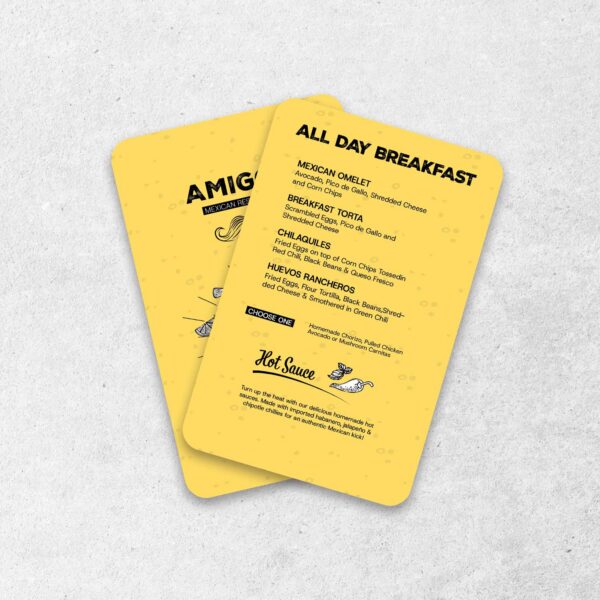
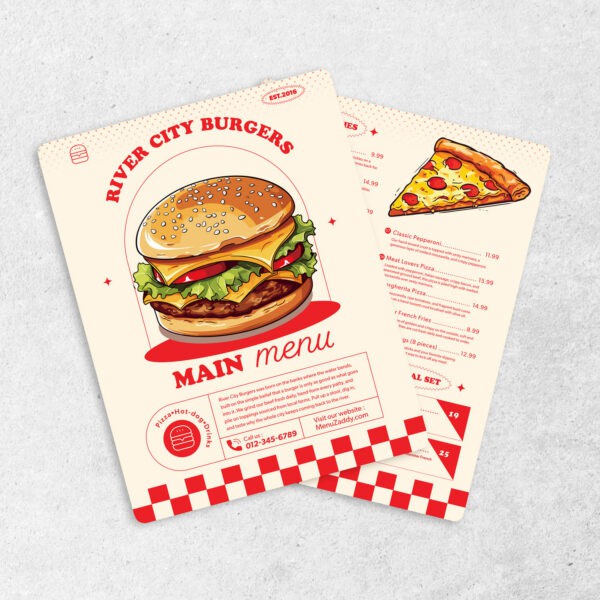
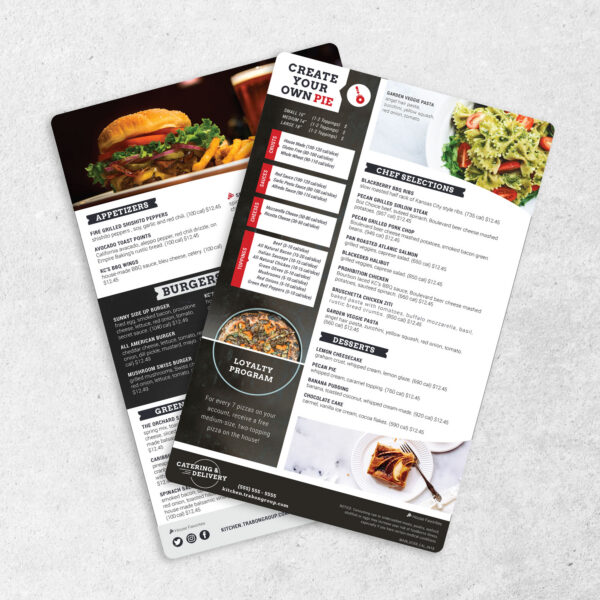
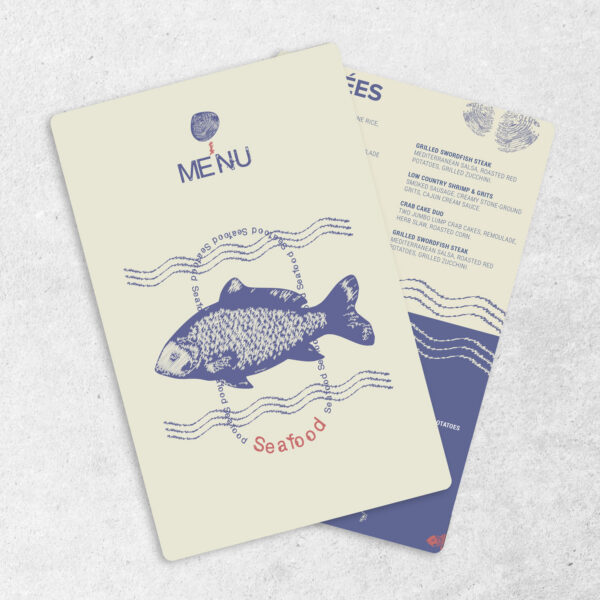
Every size prints on the same waterproof synthetic paper. Choose the format that fits your menu.

How does menu size change the thickness you need?
Larger sheets flex more at the same caliper. A thickness that feels solid at 5.5 by 8.5 can feel floppy at 11 by 17.
The physics is unavoidable. A sheet held at one edge bends under its own weight, and the longer the unsupported span, the more it bends. Doubling the dimensions of a menu while keeping the same stock produces a noticeably limper object, even though nothing about the material changed.
This is why thickness and size have to be chosen together rather than one after the other. Picking the size first and then defaulting to whatever stock the printer usually runs is how restaurants end up with a large menu that droops when a guest holds it open.
The practical rule is that caliper requirements rise as dimensions grow. At small sizes the difference between neighbouring stock weights is subtle. At large sizes it is the first thing a guest notices picking the menu up.
If you have not settled on dimensions yet, that decision comes first. Our guide on restaurant menu sizing covers choosing the size itself, including type size and how many dishes fit.
Does a thicker menu last longer?
Not by itself. Thickness controls stiffness and hand feel. What determines how long a menu survives is what the material does with moisture and oil.
A thick paper menu and a thin paper menu fail the same way. Both absorb liquid into the fibre, both stain, both go soft at the corners. The thicker one takes longer to get there, but the failure mode is identical because the material is identical.
The same applies in reverse. A thinner non-absorbent sheet can outlast a much thicker paper one in a wet room, because the thing that kills the paper menu is not a lack of caliper.
Treat them as two separate decisions. Material decides whether the menu survives spills, grease and humidity. Thickness decides whether it feels right in a guest's hand and lies flat on a table. Buying thicker paper to solve a durability problem usually means buying the wrong thing.
There is one place they overlap. A thicker sheet resists creasing and corner damage from handling, which is wear rather than material failure. That is real, but it is a smaller effect than the material choice.
What thickness do synthetic menus come in?
Synthetic menu stock is commonly offered in 12 mil and 15 mil. Those are 12 and 15 thousandths of an inch, the same as 12 pt and 15 pt.
Against the caliper figures above, 12 mil sits just above 100 lb uncoated cover at 11 points, and 15 mil sits above the heaviest uncoated cover in the table at 13.5 points. So both synthetic weights are in card stock territory rather than paper territory.
The difference between the two is weight and rigidity, not water resistance. Both are the same material. The thicker sheet holds its shape better under repeated handling and feels more substantial. The thinner one is more flexible and costs less.
Where you notice the gap depends on the size. On a small drinks menu the difference between 12 and 15 mil is subtle. On a large format sheet it is the first thing you feel when you pick it up.
Menu Zaddy prints both weights across five flat sizes. The free sample pack includes printed samples so you can handle the difference rather than guess at it from a number.
What goes wrong when a menu is too thin or too thick?
Both directions have a cost. Too thin and the menu flops and creases. Too thick and you pay for weight that does nothing for the guest.
Too thin shows up immediately. The sheet bends when held at one edge, corners curl, and creases set permanently once a guest folds it back. On a large format the menu will not stand up in a holder. None of this is subtle, and guests read it as a signal about the restaurant.
Too thick is less obvious because the menu looks fine. The costs land elsewhere. Heavier stock costs more per sheet, ships heavier, and takes more room at the host stand. At quantity those add up without improving anything a guest experiences.
There is also a storage consequence nobody plans for. A stack of 200 heavy menus takes meaningfully more shelf space than a stack of 200 lighter ones, which matters in the cramped spot most restaurants actually keep them.
The sweet spot is the lightest stock that still lies flat and holds its shape at your chosen size. Past that point extra caliper is spending without return.
How should you choose?
Work in this order: decide the size, decide the material, then pick the lightest caliper that stays flat at that size in that material.
Start with size, because it sets the minimum caliper. A small sheet is rigid at weights that would flop at large format, so settling dimensions first narrows the thickness question considerably.
Choose the material next, on how wet and greasy the room is rather than on thickness. That decision drives how long the menu survives, and it is independent of caliper.
Then pick caliper by what the menu has to do. Reused and handed to guests means enough body to stay flat. Sitting in a cover means the cover does that work. Printed to be given away means thickness is just cost.
When you ask for quotes, ask for caliper in points or mil rather than weight in pounds. That is the only way to compare two printers honestly, and the table above shows why: the same stated poundage can vary by more than half in actual thickness.
The last step is to handle it. Caliper is a number until it is in your hand, and the gap between two neighbouring weights is easier to feel than to read about. Order a free sample pack and hold both before committing to a run.
Frequently asked questions
Is a mil the same as a point?
Yes. Both mean one thousandth of an inch. A 14 pt card stock and a 14 mil synthetic sheet are the same thickness, though not the same material.
How many mil is 100 lb cover stock?
It depends on the finish. Case Paper lists 100 lb cover at 13.5 points uncoated, 11 points dull coated and 9.5 points gloss coated. All three are sold as 100 lb.
Why does the same paper weight have different thicknesses?
Weight measures how much a ream weighs, not how thick the sheet is. Coating and calendering compress the sheet, so a coated sheet can weigh more while measuring thinner.
What is the best thickness for a restaurant menu?
For a reused menu handed to guests, stocks in the low teens of points hold their shape well. Smaller menus tolerate less, and inserts inside a cover need far less.
Is 12 mil or 15 mil better?
Neither is better. 15 mil is more rigid and feels more substantial, 12 mil is more flexible and costs less. The gap is subtle at small sizes and obvious at large ones.
Does a thicker menu last longer?
Only against creasing and corner wear. Resistance to spills, grease and humidity comes from the material, not the caliper, so thicker paper is still paper.
What should I ask a printer about thickness?
Ask for caliper in points or mil. A quote in pounds alone does not tell you how thick the sheet is, because finish changes the answer substantially.

